

Search experiences utilizing generative AI, such as Google's “AI Overview” and ChatGPT, have spread, and a new optimization method “AIO optimization (AI optimization)” different from SEO up until now is attracting attention.
In addition to raising the ranking of search results as before, we are entering an era where whether or not it is selected by AI as an information source affects attracting customers on the web and brand recognition.
In this article, I will explain a wide range of topics, from the basics of AIO countermeasures to differences from SEO, effective optimization methods, and even the latest trends as of 2025.
Based on the experience of countermeasures that I have actually tested, I will tell you concrete measures “that can be implemented” to respond to the coming search era.

AIO countermeasures are an abbreviation of “AI optimization (AI optimization),” and it refers to efforts to optimize one's own website and content so that when AI directly displays answers in search results, such as Google's AI Overview or ChatGPT, it is easier to be quoted by AI.
Conventional SEO (search engine optimization) was a method of targeting clicks by displaying it at the top of search results, but in AIO, the purpose is to be selected as a source of information for AI to refer to.
For example, when a user searches for “how to do 00,” when AI generates the answer, it generates sentences by referring to your site, which is the result of AIO countermeasures. In other words, it is important to create content that can be conveyed not only to people but also to AI.
As the use of AI search expands further in the future, it can be said that AIO countermeasures will be a new key to attracting customers and raising awareness. It is a measure worth working on now, even in the sense that it complements search routes that cannot be taken by SEO alone.
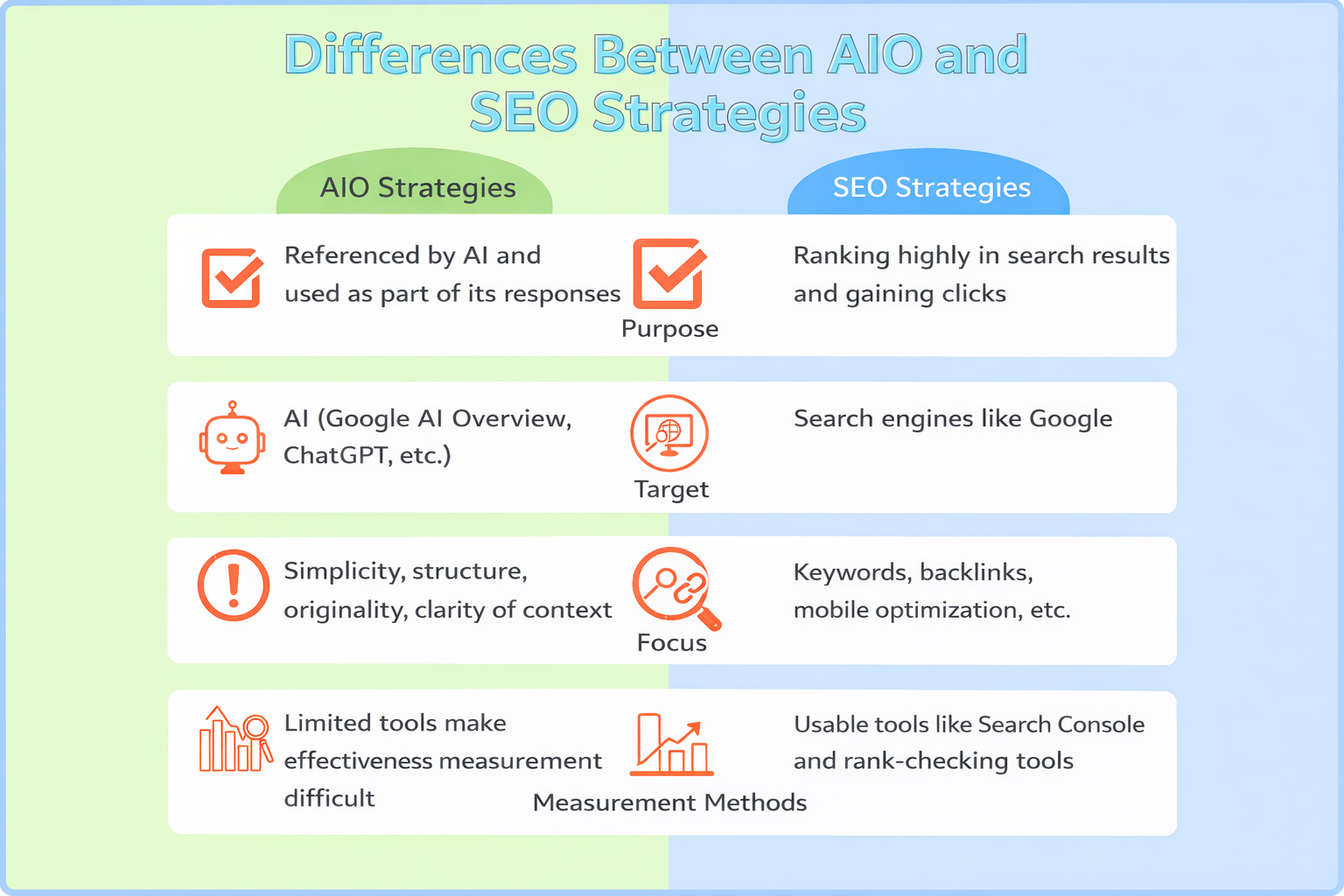
Both AIO measures and SEO measures are measures to “get people to find their own content,”There are differences in purpose and method.
The purpose of SEO is to be displayed at the top of Google search results, and the main thing is to encourage clicks. On the other hand, AIO countermeasures are cited in generative AI (AI Overview, ChatGPT, etc.)That is the purpose.
Let's quickly summarize the differences between them in the table below.
Comparative items
SEO measures
AIO countermeasures
The main purpose
Top ranking in search results and getting clicks
Cited by AI and used as part of the answer
object
Search engines such as Google
AI (Google AI Overview, ChatGPT, etc.)
Points to focus on
Keywords, backlinks, mobile support, etc.
Simplicity, structure, uniqueness, and clarity of context
Measurement method
You can use Search Console and ranking check tools
There are still few clear tools, and measuring effectiveness is difficult
In SEO, emphasis is placed on ingenuity in titles and meta descriptions aimed at user clicks, but in AIOStructure that makes it easy for AI to read and the presence or absence of primary informationwill be important.
not one or the other,Do SEO and AIO in parallelAs a result, it is possible to develop stronger content that is compatible with both conventional search users and AI search users.
Designing content from both perspectives will become the new normal for web strategies in the future.
Until now, Google has been the center of search, but the shape of search is about to change drastically due to the evolution of AI technology in recent years.
In particular, as “zero-click searches,” where users are satisfied with only summaries and answers by AI, are spreading, how they are quoted by AI is becoming extremely important in attracting future web customers.
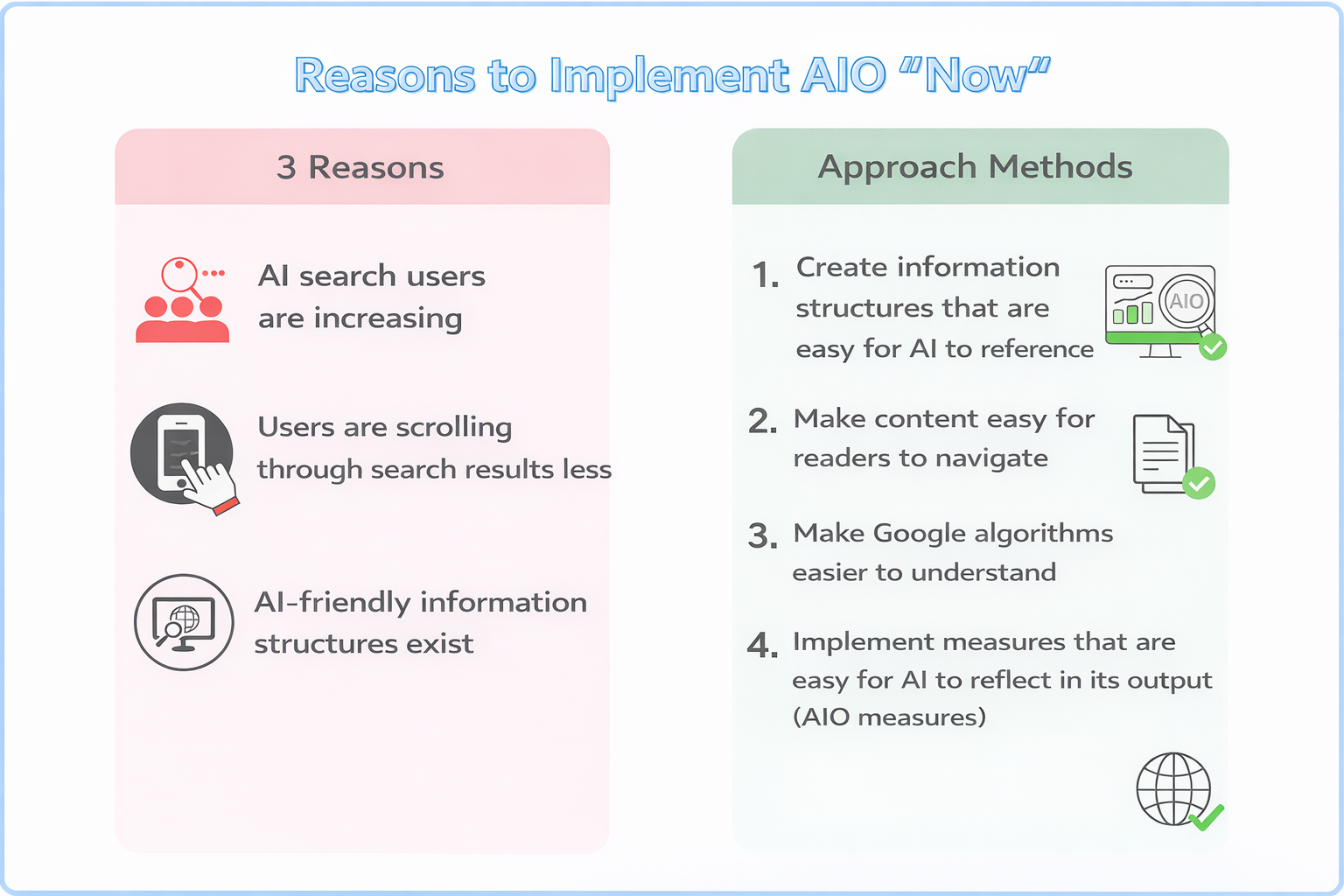
So why do we need AIO countermeasures now? I will explain it from 3 perspectives.
Until now, when it comes to searches, the era where Google is the strongest has continued, but now the number of users using AI answer-type search services such as ChatGPT and Perplexity is gradually increasing.
These AI search services use a mechanism where AI directly answers questions in sentences instead of displaying search results as a list with blue links.
Google has already introduced a new function called “AI Overview (Japanese name: Overview by AI),” and answers automatically generated by AI are now displayed at the top of search results.
Although conventional search systems will not completely disappear, it is expected that future search experiences will shift from conventional click-based searches to summary/answer searches via AI.
At that time, whether or not your company's information is used to respond to AI will make a big difference in attracting customers and gaining recognition.
There are definitely fewer opportunities for users to dive deeper into search results than before. The reason behind this is the influence of Google's AI Overview function.
When entering a search keyword, the first thing that is displayed is not a conventional list of web pages, but a simple answer generated by AI.
As a result, there are an increasing number of cases where users are satisfied with just that and end their search without scrolling to the bottom of the page. This is particularly evident when it comes to search queries that are solved one question at a time.
This change shows a new evaluation axis where whether or not it is displayed within the AI output is more important than how high it was displayed.
By implementing AIO countermeasures, it is possible to increase the chances that in-house content will be quoted in this AI response part, and information can be spread to those that cannot be reached by conventional SEO alone.
Until now, when creating a website,
As you can see, it has been important to devise the structure of sentences and how to use tags. From now on, another viewpoint of information structures that AI can easily understand will be added to that.
Since AI creates answers by reading the overall flow and logical structure of sentences, it is necessary to organize information that is slightly different from how easy it is for humans to understand.
The FAQ format, conclusion first sentence structure, clear evidence presentation, etc. are forms that are easy for AI to cite.
It is a countermeasure similar to SEO, but since the mechanism actually adopted by AI is different from Google's search algorithm, optimization from a new standard/perspective is necessary.
AIO countermeasures do not necessarily have an effect even if content is created blindly. Here, we will introduce 3 basic steps to keep in mind when implementing AIO countermeasures.
The first thing I want to do is check how my site is currently being rated by search engines like Google.
This is because generative AI basically preferentially crawls and learns pages that are published on the web and have a certain high evaluation, so it is extremely unlikely that articles outside the search range will be quoted by AI.
Therefore, let's first check how high the target article is displayed in terms of SEO by using Search Console or ranking check tools, etc.
Furthermore, if there is almost no evaluation, a basic SEO review is necessary before AIO countermeasures.
The point of AIO countermeasures is to think of them as “additional measures” to make sites that have a certain level of foundation in place so that they can also be selected from AI.
The next most important thing is to correctly select articles and topics suitable for AIO countermeasures.
Actually, AI doesn't generate answers to every search query. For example, “informational queries (searches where you want to know information)” such as “what is ◯◯” and “how to do ××” are fields that AI excels at, and there is a tendency for AIO countermeasures to be effective.
On the other hand, navigation queries (searches to get to specific pages) such as “0 site name 0 login” and “◯◯ official site” are genres where there is little room for AI to intervene, and it is difficult to be displayed even when AIO countermeasures are taken.
There aren't many cases where articles are actually created with navigation queries, but in other words, determining “which articles to apply AIO countermeasures to” is an important step that affects results.
Let's determine and select from existing articles whether it is a subject where AI is easy to intervene.
Once the articles to be counteracted have been decided, it's time to start creating or rewriting content.
If there is already an article on the subject in question, it is important to rewrite it in a form that is optimal for AIO. For example, by incorporating an FAQ format, arranging a conclusion first structure, and adding primary information and unique opinions, the probability of being quoted by AI will increase.
If there are no articles on that subject, be sure to create new AIO-conscious content.
At this stage of new creation, in addition to being easy for search users to understand, it is important to be aware of “whether the structure makes it easy for AI to extract information.”

In order to implement AIO countermeasures, it is necessary to optimize content technologically and structurally after understanding how AI acquires information, understands it, and uses it for responses.
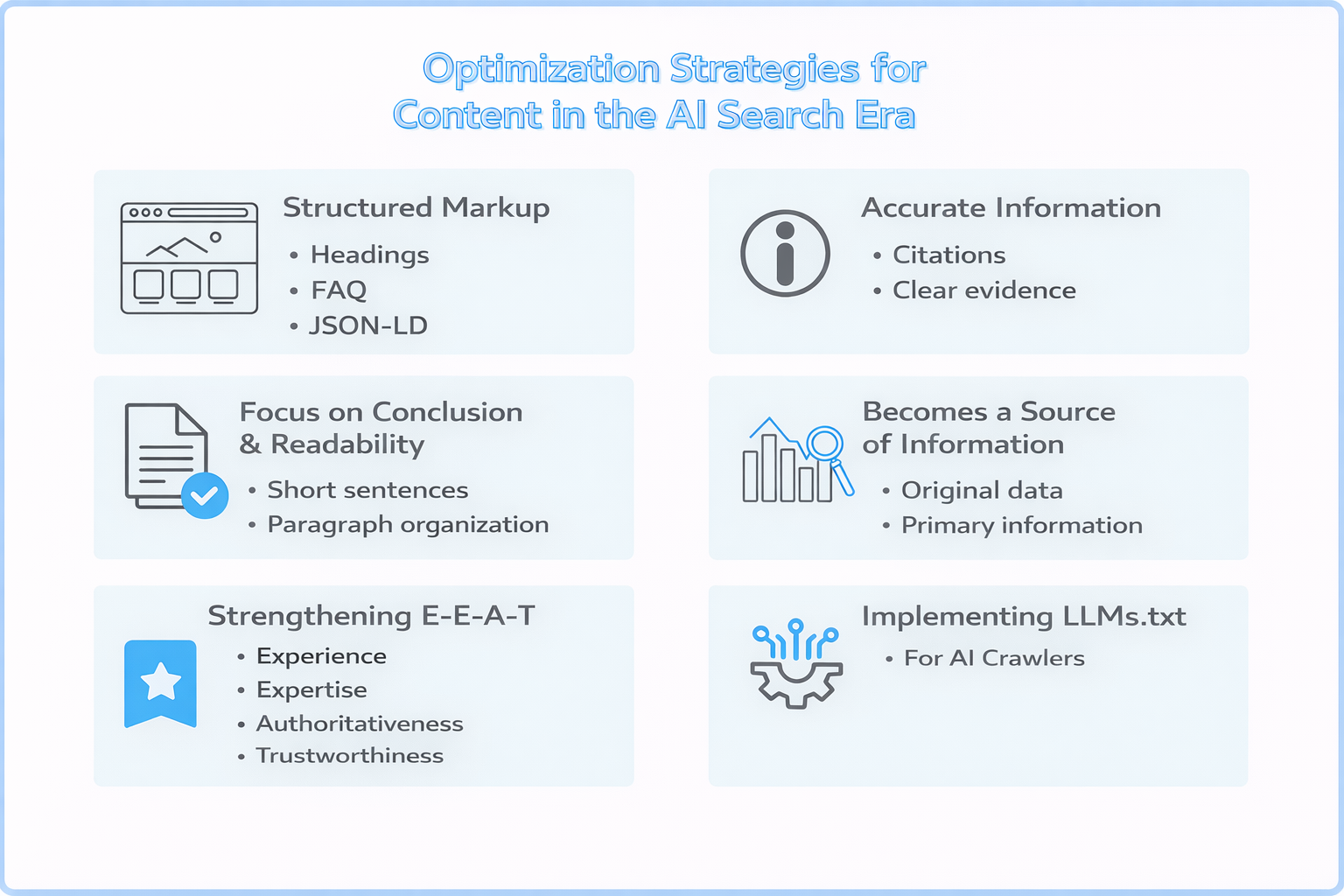
Implementing structured markup is an effective first step in getting AI to correctly understand information.
particularlySchema.orgMarkups for FAQ schemas and knowledge panels that utilize help AI read the meaning of content, so the possibility of being quoted increases a lot.
For example, if an FAQ schema is used, clear answers are provided in a Q&A format, so it is also suitable for displaying a question one answer type by AI.
Also, it is important to properly use heading tags (h1 to h3, etc.) to organize sentence structure and create a logical flow. Furthermore, when describing structured data, use the JSON-LD format recommended by Google and describe all necessary items without omission.
If you are using a CMS such as WordPress, you can easily implement it by using a dedicated plug-in.
What is important in AIO countermeasures is to have AI determine that this information is reliable.
Therefore, what is emphasized is “E-E-A-T,” which also appears in the Google search quality evaluation guidelines.
This is
It is a concept that takes the acronym of, and it is also a judgment material for AI to measure the value of content.
AI search engines tend to prefer reliable information, cite it in answers, and display it as featured snippets (highlighted snippets) or knowledge graphs.
In other words, creating content that is conscious of E-E-A-T not only increases the rate of citations from AI, but also increases the possibility that it will be displayed prominently at the top of search results.
As a result, it also leads to increased traffic to websites and increased brand awareness, which can benefit from both SEO and AIO.
Strengthen E-E-A-T by clearly stating author information, providing technical descriptions, and obtaining external backlinks.
In order to create content that is quoted by AI, it is essential to have a sentence structure that can be understood quickly.
The basis for this is the conclusion first sentence. In particular, when using question headings in h2 or h3, the ideal structure is to show the answer first in the text immediately below it and then supplement the reason or rationale.
Also, if the subject and predicate are too far apart in a sentence, or if one sentence is too long and complicated, it becomes difficult not only for readers but also for AI to understand.
Furthermore, in order to improve readability, try to keep each sentence as short as possible and focus on one point of discussion per paragraph.
These sentences, which are fast in conclusion and are highly readable, are effective not only for AI, but also for snippet countermeasures in SEO, and are directly linked to creating human-friendly content.
The accuracy of content is also an important factor in gaining trust from AI.
Generative AI extracts and summarizes information from multiple web pages in order to present optimal answers to search queries. At that time, in order to be recognized as a reliable source of information for AI, it is important to specify the source and clearly indicate that it is well-founded information.
Also, AI searches developed by Google etc. are currently in the test operation stage, and feedback on “whether they were helpful” is being collected from users.
This is a function that evaluates AI searches rather than the website itself, but in the unlikely event that incorrect information is described, it may lead to an evaluation that is not worth referring to, so be careful.
In the future, algorithms may also be introduced in which sites that repeat incorrect information are judged to be “unreliable.” In the AI search era, more than simply writing in an easy-to-understand manner, conveying accurate information with citations will be the key to becoming a site of long-term choice.
In addition to AIO measures, the most ideal SEO countermeasure is for the company's content to become the “citation source” itself.
When evaluating the reliability of information, AI tends to prioritize information specified as sources or pages providing primary information. Therefore, instead of compiling information sent by other companies, it is effective to post data and unique considerations that have been investigated and covered by oneself.
Of course, when quoting from other sites, it is also important to specify the correct source and show an attitude of ensuring the reliability of the information. However, be aware that what is more likely to be evaluated is not the “side that quotes,” but the “side that is quoted.”
Also, even for keywords without search volume, information with perspectives and perspectives not found on competitor sites is more likely to be evaluated by AI as “highly specialized content.”
Delivering primary information that is really valuable to users without being bound by the number of searches is a shortcut to being selected from AI.
The introduction of LLMS.txt is attracting attention as a technical ingenuity to have AI correctly read the company's information.
This is a new-format guide file that generative AI such as ChatGPT or Google's AI Overview refers to when visiting and learning websites. It has a role similar to robots.txt and siteMap.xml used in SEO, and can tell AI crawlers what information they want them to read.
By installing LLMS.txt, AI can efficiently crawl only necessary pages, increasing the accuracy of information and the possibility of being quoted. On the other hand, care must also be taken when used in combination with robots.txt so that unnecessary information or management area pages are not accidentally crawled.
Also, on the contrary, it is important to review the settings so as not to block necessary crawlers (OpenAI, Perplexity, etc.).
Currently, there are still few sites that have introduced it, but since there is a high possibility that it will become a standard in the future, it is possible to take AIO countermeasures one step ahead by preparing early.
AIO countermeasures cannot be easily determined by numerical values such as click through rate (CTR) or page views (PV) like conventional SEO measures, and the difficulty of measuring effectiveness has become a major issue in AIO.
Here, we will introduce a method for checking the results of such AIO countermeasures.
The most primitive yet reliable method for AIO countermeasures is to “actually search and confirm by yourself.”
We search for target keywords with AI Overview, ChatGPT, etc., and determine by visually looking at how the content on our site is displayed. It takes time and effort, but being able to grasp important information that cannot be seen in numbers, such as display format, location, and how it is handled within context, is a major advantage.
However, since it is not realistic to check every article each time, the point is to focus on important articles and key keywords.
Also, since search results tend to fluctuate, it is important to make regular checks a habit.
Recently, data measurement tools that specialize in AIO have also begun to appear. For example,
Some tools, such as, are equipped with a function to report the display status in Google's AI Overview.
As a result, it is possible to grasp to some extent information such as how many AI responses the company's pages have appeared in AI responses and which keywords were displayed.
However, as a caveat, AI search results are often personalized according to each user's search history, language settings, etc., and the data acquired by the tool is not necessarily accurate.
Also, since there are cases where the AI response part ends with “zero clicks,” which is difficult to lead to clicks, it is necessary not to overtrust only numbers, but to determine the effects by including the viewpoints of user behavior and brand recognition.

When implementing AIO countermeasures, it is necessary not only to repeat measures with the aim of being picked up by AI, but also to keep in mind points to prevent the opposite effect.
When working on AIO countermeasures, what is often thought of as a zero-click countermeasure is forcibly incorporating the company's service name or brand name.
There is a risk that evaluations from AI will be lowered if sales elements or expressions with strong advertisement colors are included in sentences due to being too aware of sales.
Since AI requires neutral and objective answers to users' questions, sentences with excessive brand appeal are judged to be “unreliable as reference information,” making it difficult to be quoted.
At the end of the day, the top priority is that it is conveyed as natural and useful information when read by AI. Keep appeal to the minimum necessary, and be aware that it will be selected as a useful source of information first.
AIO measures and SEO are different things, but in a state where the underlying SEO is not in place, it becomes difficult to be quoted by AI.
For example, articles that are buried after page 3 of search results are less likely to be viewed by AI in the first place, making it difficult for countermeasures to be effective.
Therefore, it is important to first go back to basics, review the content and structure of the article, and aim for content that is evaluated by search engines.
In the sense of delivering high-quality information, there are many parts where SEO and AIO overlap, and implementing SEO properly will eventually lead to AIO countermeasures.
Instead of “concentrating only on AI optimization,” promoting SEO and AIO in parallel can be said to be a realistic and effective operation method.
“Taking first place in the ranking of search results = being quoted in AI searches” does not necessarily mean.
In AI Overview, information is structured independently of search rankings, so pages displayed in 1st place as conventional blue links may not be adopted by AI at all.
Also, the position where the AI Overview is displayed is not always the same every time, and it is not uncommon for advertisements to be placed at the top, and cases where the AI-generated answers themselves are displayed around 3rd or 4th place.
In other words, if you think that being quoted from AI is the goal, there is a possibility that you will not be able to correctly judge results.
In order to maximize website sales and results, use each search query
Let's try to look at things from a multifaceted perspective.
What you need to know when considering AIO countermeasures is that Google isn't the only AI search.
Currently, in addition to Google's AI Overview, there are multiple AI search services such as ChatGPT, Perplexity, and You.com, and each company uses different algorithms. For example, Google emphasizes reliability and structured data on the web, and ChatGPT focuses on the accuracy of natural language processing and contextual understanding with users.
Nonetheless, it is impractical to take individual measures for all of these. However, as introduced in this article, if you hold down common evaluation points that AI likes, such as providing accurate information, easy-to-read structures, and primary information, you can naturally have a positive impact on multiple AI searches.
Finally, what I want to understand when proceeding with AIO countermeasures is that there is no clear correct answer that “if you do this, it will always be quoted by AI.”
Conventional SEO showed a trend of ranking rising to some extent due to keyword countermeasures and internal link measures, etc., but in AIO, searches have diversified into conversation formats, voice input formats, etc., and results tend to change every time according to search intentions and circumstances.
Also, since answers are generated by referring to information such as an individual's past search history, regions, and devices, flexible and essential measures are required to respond to personalized results.
Additionally, AIO is still an evolving technology, and there is a good chance that measures that seem effective now will be ineffective in a few months.
Therefore, it can be said that the greatest countermeasure is the attitude of continuously updating information and continuing to steadily disseminate reliable information rather than being disappointed with the results of countermeasures.
“Potemkin understanding” is a concept that has been attracting attention in recent years regarding the “comprehension ability” of generative AI.
This is a phenomenon where LLM (Large Language Model) shows high scores in benchmark tests, but is not understood in the true sense of the word in actual applications.
[Origin of Potemkin]
It comes from an anecdote that the Russian soldier Potemkin showed an unreal taibote village for inspection by Empress Catherine II. The research team from MIT, Harvard University, and the University of Chicago who presented their research details on 2025/6/29 named it.
This behavior that makes it seem like they understand is different from Hal Nation, which creates false facts, and is called pretending to understand, that is, “fabricating a concept.”
There are concerns about the risk that incorrect information will be displayed in medical care, finance, laws, etc. called YMYL (Your Money or Your Life) in the future, and there is a possibility that the impact on search quality and SEO will be even greater in the future.
Reference source:https://arxiv.org/abs/2506.21521

Google's AI Overview was introduced, and AIO countermeasures started when it became clear that the number of clicks would decrease even on conventional top search articles.
The measures actually implemented include introducing an FAQ structure, implementing structured data (FAQ Schema), documenting conclusions first, and specifying sources.
What was particularly impressive was that it became easier for articles containing primary information and testimonials to be quoted by AI. While there were almost no results in articles summarizing only general-purpose information, survey results conducted in-house or content with unique opinions are increasingly taken up naturally within AI responses.
However, even if it is quoted, there are many cases where it ends with zero clicks, and I feel once again that it is important whether it is recognized below as a brand.

AIO countermeasures are not just a fad; they are essential measures to respond to future search experiences.
It is not a complete replacement for SEO, but having a new perspective of aiming for content cited by AI will influence the quality and results of future information dissemination.
What is important is to deliver accurate and reliable information to both AI and humans in an easy-to-understand manner. Also, it can be said that it is an attitude of continuous improvement while devising the structure and style.
There is no correct answer that says “it's OK if you just do this” for AIO countermeasures, but if you are aware of the points introduced in this article, you should be able to take the first step towards creating a site that is easily selected by AI.